Sonar Vortex is a new product from Sonar designed to make AI-based code agents more efficient, controlled, and secure, through deep integration with SonarQube and an agent-driven development loop.
Vortex unifies Context Augmentation and Agentic Analysis capabilities into a single product that operates within the agent’s own inner loop – at an early stage and in real time – instead of later checks during the Pull Request (Merge Request) stage or the “classic” CI.
What Does Sonar Vortex Do?
In the Guide stage (the stage where context is provided to agents before they write or edit code),
Vortex “injects” additional and crucial content into the agent’s context: a repository map, architecture rules, security policies, team conventions, and approved libraries, so that the code is written from the outset according to organizational standards.
In the Verify stage (the stage where code is analyzed and validated after it is created), any change made by the agent is checked in real time against SonarQube’s algorithmic analysis engine – bugs, vulnerabilities, code smells, test coverage, duplications, and Quality Gate – even before a Pull Request (or Merge Request in GitLab) exists.
This results in fixes and changes that comply with governance without the need for additional linters or static prompt files that require maintenance.
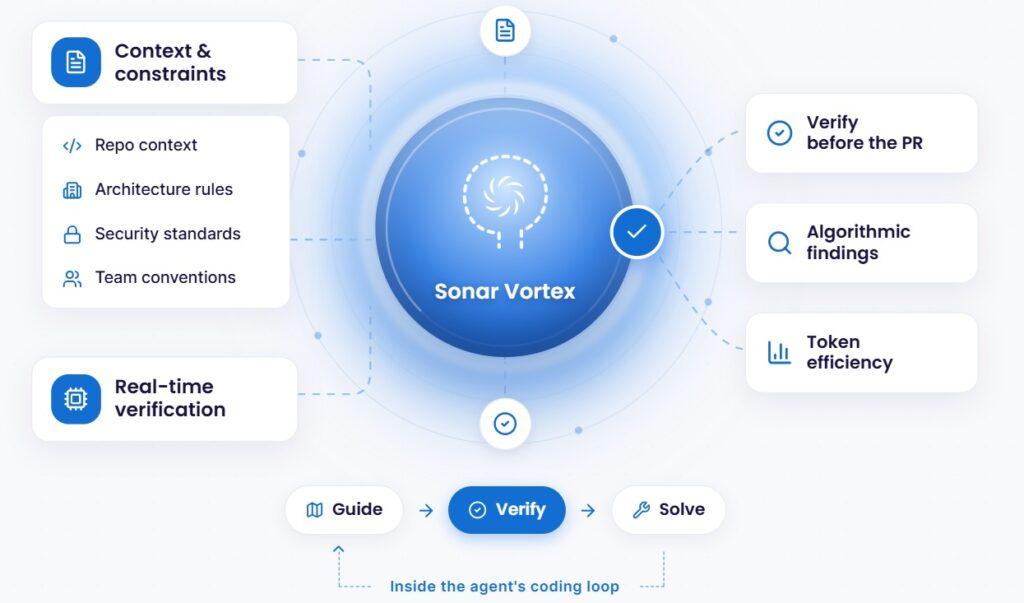
Illustration of Vortex as part of the development process (click to enlarge)
Key Capabilities of Vortex
Vortex operates in a continuous loop of Guide + Verify: it first adds context and boundaries to the AI coder (Repository map, architecture rules, security policies, approved libraries), and only then lets it write code.
Every change is immediately checked against SonarQube’s algorithmic analysis engine, including security vulnerabilities, bugs, code smells, test coverage, and Quality Gate, even before a PR is created.
This yields better quality right from the first prompt, less architectural drift, and a significant reduction in token consumption.
Benefits and Use Cases:
In tests on projects written in Java, Python, TypeScript, and C#,
the Vortex product showed up to a 36% reduction in token consumption for refactoring tasks, where finding the relevant code is most of the work.
It reduces CI failures, lowers the risk of bugs and code full of security vulnerabilities,
and minimizes architectural drift by catching issues inside the agent’s loop and not just at the end of the pipeline.
The product is built to work with the existing toolset:
Integration via SonarQube CLI or MCP Server enables quick connection
to Claude Code, GitHub Copilot, Cursor, Gemini Code Assist, Codex CLI
and additional custom agents, while utilizing existing SonarQube rules and quality profiles.
Integration into DevSecOps
Vortex does not replace the CI but shifts testing and feedback to an earlier stage (within the agent’s loop),
so that fewer problematic changes reach the pipeline and the CI remains green.
It utilizes existing SonarQube rules, quality profiles, and governance, and works with IDEs, CLIs, or MCP-compatible agents such as Claude Code, GitHub Copilot, Cursor, Gemini CLI, and more.
By doing so, it provides a unified DevSecOps layer for all AI agents in the organization, without rewriting existing processes.
Summary:
By using Vortex, you can write higher quality and more secure code, saving money on tokens and development time spent on AI-driven fixes.
For more details, contact us: sonar@almtoolbox.com or call us: 866-503-1471 (USA / Canada) or +31 85 064 4633