Recently, Docker (which we represent) has begun offering a control and governance solution for AI agents.
In light of questions on this topic, I wrote an explanation of what this is and the value this solution provides.
For questions, you can contact us – details below.
Docker AI Governance is a centralized solution for managing, securing, and controlling AI agents and Claws.
It allows organizations to define centralized policies regarding the actions the Agent is permitted to perform, the destinations it is allowed to connect to, the files it is permitted to access, and the MCP tools it is allowed to execute.
Why Do You Need AI Governance for AI Agents?
AI agents are not just chat tools.
AI agents, especially Coding agents, data agents, and operations agents, can read and write code,
access repositories, invoke APIs, use credentials, and perform actions in organizational systems.
Without centralized control, it is difficult to know what the Agent did, what resources were available to it, and what will happen if it receives a wrong instruction or acts in an unexpected manner.
Docker AI Governance is designed to add guardrails at the execution environment level.
Instead of relying solely on model instructions or local configuration,
policies are enforced at the runtime level using Docker Sandboxes, Network controls, and MCP Gateway.
What is the Docker AI Governance Offering?
Docker AI Governance is a centralized governance layer managed through Docker Home or Docker AI Platform. Organization administrators define policies at the organization or team level, and the policy is distributed to developer environments through the enterprise authentication and management process.
Docker’s AI Governance solution includes:
- Centralized admin console for defining Network, Filesystem, and MCP policies.
- Docker Sandboxes for running Agents in an isolated microVM environment.
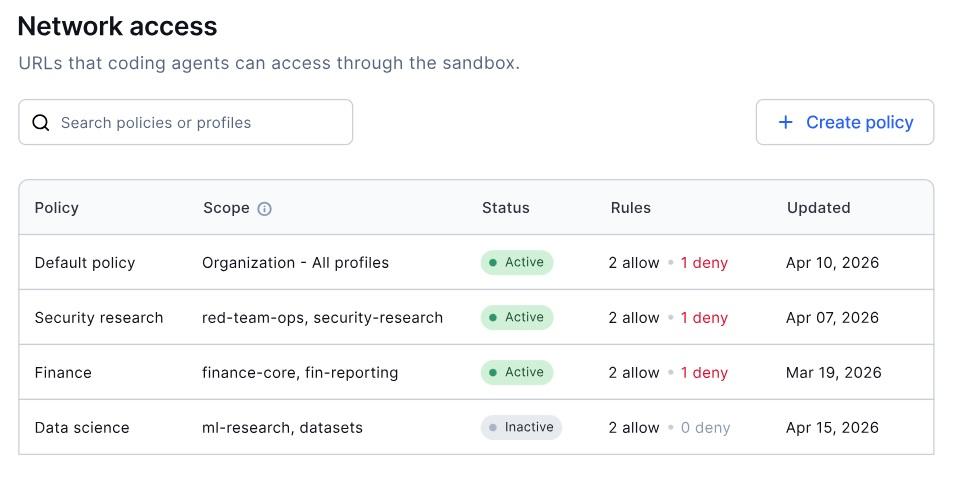
- Network access policies to control outbound traffic.
- Filesystem access policies to limit host paths and mount permissions.
- MCP access policies to control MCP servers, tools, resources, and prompts.
- Credential injection via a host-side proxy, so the Agent does not need to receive the secret value itself.
- Audit events and the ability to stream data to SIEM systems.
- Governance API for programmatic policy management.
The Four Control Surfaces in This Solution:
1. Network Access
Organization administrators can define which domains, IP addresses, CIDRs, and ports are available to the Agent. Outbound TCP traffic from the Sandbox passes through a proxy on the host, where Network policies are enforced.
This allows enabling access to GitHub, GitLab, package registries, or internal APIs, while simultaneously blocking unnecessary destinations.
2. Filesystem Access
Filesystem policies determine which paths on the host can be mapped into the Sandbox. Mounts can be defined as read-only or read-write.
This means the Agent has no general access to files on the developer’s computer. It only receives the workspace and the paths defined in the policy.
3. Credentials
Docker describes a mechanism in which credentials are injected via a host-side proxy. The Agent can make an authenticated request, but the secret itself does not need to enter the microVM or be exposed to the Agent’s process.
This approach reduces the need to paste API tokens into prompts, configuration files, or code under the Agent’s control.
4. MCP Tools
Model Context Protocol (MCP) allows the Agent to connect to external servers and tools. Docker AI Governance provides centralized control over which MCP servers can be registered and what actions are permitted to be executed through them.
MCP policy is written using Cedar and can control server registration, tool calls, resource reads, prompt retrieval, and approval gates. When Governance is active, MCP activity is effectively default deny: any action not explicitly allowed is blocked.
How is the Policy Enforced?
Docker Sandboxes run the Agent inside a microVM isolated environment. Docker AI Governance serves as the control plane that defines the policy, while enforcement occurs at the points where the Agent accesses the resource.
The policy consists of Policies and Rules. Each Rule includes an action, a resource, and an allow or deny decision. Two important principles are:
- Deny wins: If a deny Rule matches the request, the request is blocked even if another Rule exists that allows it.
- Default deny: A resource not allowed through a corresponding Allow or Permit remains blocked.
Docker documents that changes to Organization policies can take up to five minutes to reach developer machines. You can run sbx policy reset to force-pull a new policy.
About ALM Toolbox:
ALM Toolbox is the official senior partner of Docker in Israel and many other countries (“Preferred Partner”),
with rich experience in Docker products both professionally/technologically and commercially (licensing sales and correct, cost-effective license management).
The company offers a wide range of solutions around the product, including designing and setting up environments, managed services on private cloud, consulting, license sales, integration with complementary tools (such as GitHub, GitLab, Jenkins, SonarQube, Argo, Bitbucket, Azure DevOps, Kubernetes), training, and more.
For more details, contact us: docker@almtoolbox.com
Or call us: 866-503-1471 (USA & Canada) / +31 85 064 4633
Relevant Links:
Frequently Asked Questions (FAQ)
What is Docker AI Governance?
Docker AI Governance is a centralized governance layer for controlling the actions of AI agents, including network access, files, credentials, and MCP tools.
Does Docker AI Governance replace Docker Sandboxes?
No. Docker AI Governance serves as the control plane on top of Docker Sandboxes, adding policy management, enforcement, and auditing at the organizational level.
Can MCP servers be controlled?
Yes. Server registration and actions such as tool calls, resource reads, and prompt retrieval can be controlled via the MCP Gateway and Cedar policies.
Can policies be managed via API?
Yes. Docker provides a Governance API for programmatic management of Network and Filesystem organization policies.