One of the standout advantages of SonarQube is the depth of its dedicated rules for each programming language.
Behind every scan lies a well-documented repository of checks that allows development teams to understand what issues the tool looks for,
tailor tests to organizational needs, and learn how to improve their code.
This combination turns code analysis into a manageable, transparent process.
SonarQube performs static code analysis—meaning it analyzes code without executing the application.
Static security checks are known as SAST (Static Application Security Testing), enabling teams to locate vulnerabilities early in the development lifecycle. Alongside security checks, the product performs static analysis to detect reliability and maintainability issues.
For software developers, engineering managers, and AppSec and DevSecOps professionals, this offers practical value: you can evaluate the depth of coverage for the languages your organization actually uses and establish a shared testing policy across teams.
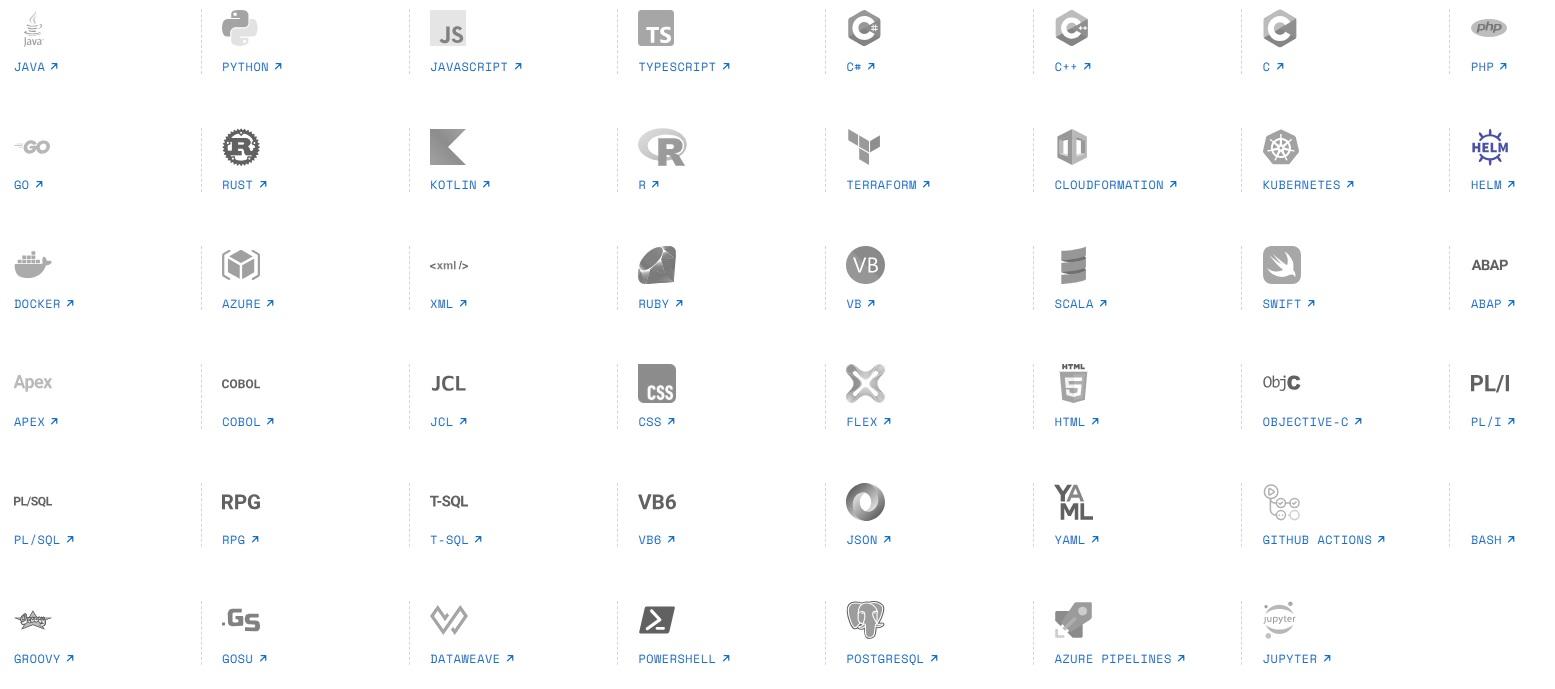
Sonar currently supports over 40 programming languages and frameworks
Language Expertise is in the Details
Every programming language has its own unique mechanisms, libraries, and usage patterns. High-quality code analysis must account for these nuances.
Over the years, Sonar has developed analysis engines and rules tailored to various languages; core languages such as C++, Java, and Python benefit from hundreds of dedicated rules each. Actual rule availability depends on the Sonar product, version, and edition in use.
Currently, Sonar supports more than 40 programming languages and frameworks.
In addition to the core languages, the analysis accounts for supported development environments and frameworks like React, Angular, and Node.js.
The exact scope of rule coverage varies depending on the product and edition.
In C++, for example, you will find rules addressing memory management, such as detecting use-after-free conditions.
In Python, checks target unique language behaviors, such as modifying a mutable object used as a default parameter in function definitions—a common mistake that can retain data across calls and lead to unpredictable bugs.
In Java, dedicated rules exist for regular expressions, unit testing frameworks, and features introduced in newer Java releases.
In C#, rules are tailored specifically for .NET development, flagging issues like async void usage in non-event-handler methods or identifying objects implementing IDisposable whose resources are not properly released. These rules prevent exception-handling errors and resource leaks.
In JavaScript, dedicated rules cover React and JSX, such as detecting improper React Hooks usage, missing key props in rendered lists, and accessibility issues in interface components.
These examples demonstrate how static analysis considers both the framework and its best practices.
They also highlight why evaluating the underlying rules directly is essential when choosing a code analysis platform.
More information and examples for Java and React can be found in the links at the end of this article.
The list of supported languages only tells part of the story; true value for dev teams comes from the specific types of flaws and bugs the analyzer engine can catch within their stack.
Documented Rule Catalog for Complete Transparency
Sonar publishes a language-by-language rule catalog.
Rule descriptions explain the issue, why it matters, and how to fix it—frequently including examples of non-compliant code alongside compliant solutions. Inside the SonarQube Rules interface, users can search and filter rules by language, severity, clean code attribute, and test profile.
This transparency is invaluable during tool evaluation.
If an organization wants to check how memory leaks, unsafe API calls, or specific code smells are handled, engineers can review relevant rules and test representative code samples. After implementation, this documentation helps developers understand why a finding was generated and what corrective action is expected.
Additional documentation on SonarQube rule management is available via the links at the end of this article.
Consistent and Deterministic Scans Using Known Rules
A major advantage of SonarQube over pure LLM-based code reviews is its deterministic static analysis engine: when code, analyzer version, rule configurations, and scan inputs remain identical, scan results are completely reproducible.
This consistency gives teams a reliable quality baseline throughout development. Updating the analyzer version or modifying rule sets will change results as expected, even if the application code itself remains unchanged.
Conversely, Large Language Model (LLM) reviews can yield variable results based on model versions, prompts, and context—sometimes producing inconsistent outputs between similar runs.
Furthermore, pure LLM scanners may miss critical issues or introduce false positives stemming from misinterpretations of the codebase.
Centralized Policy Management via Quality Profiles
A comprehensive rule repository is most effective when organizations can curate tailored testing policies. A Quality Profile defines which rules are activated during static analysis for a given language. Teams can start with a built-in default profile, create custom profiles, enable or disable specific rules, and adjust rule parameters where applicable.
For instance, an enterprise can establish a baseline profile for all Java projects and derive specialized sub-profiles with additional checks for specific systems.
Inheritance mechanisms between Quality Profiles ensure that updates made to the parent profile propagate automatically to derived profiles, helping maintain consistent coding standards across teams.
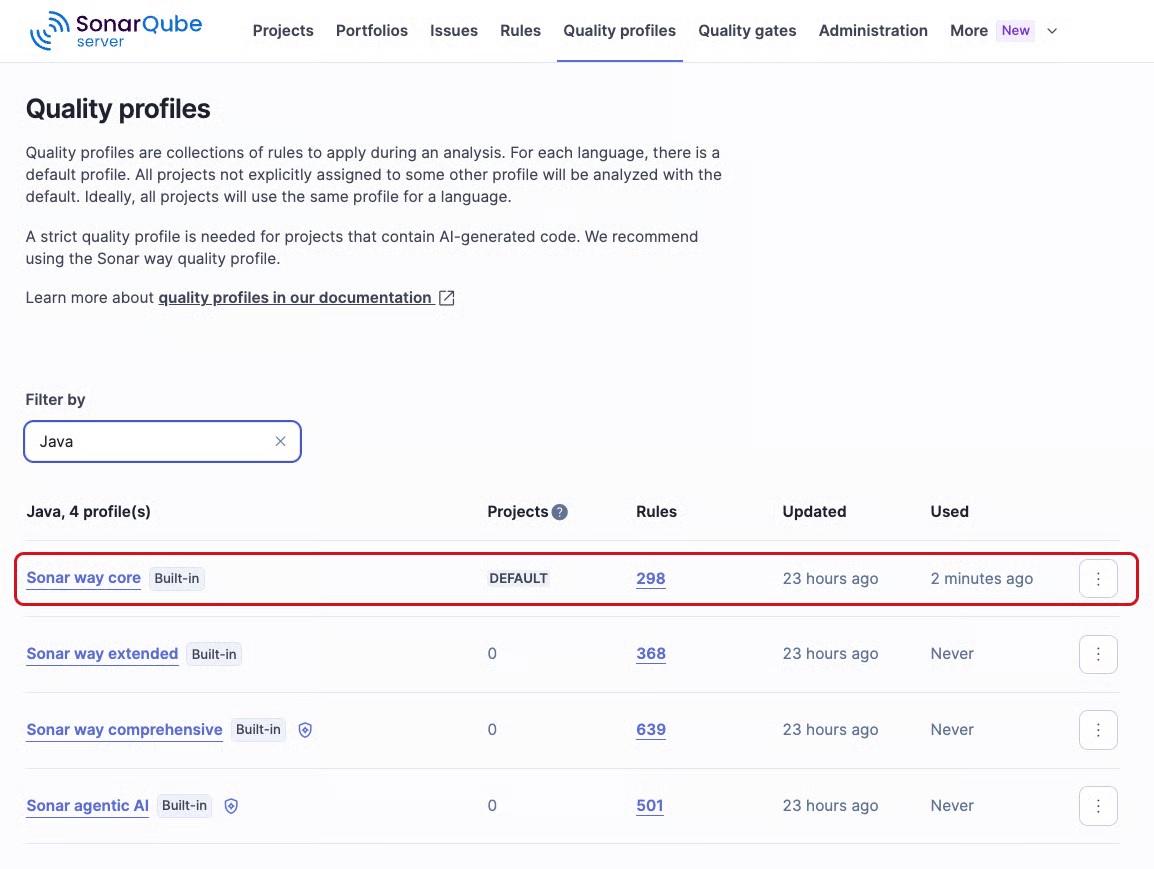
Illustration: SonarQube Quality Profile (click to expand)
It is helpful to distinguish between a Quality Profile (which dictates what is checked) and a Quality Gate (which defines the threshold conditions a project build must meet). These two mechanisms complement each other to form a complete software quality control process.
Detailed guides on Quality Profiles and profile inheritance are linked at the bottom of the post.
Reducing Noise and Evaluating Coverage
Fine-tuning rules helps focus developer attention on issues relevant to the business and codebase. However, teams should distinguish between valid findings that an organization intentionally defers and true False Positives (where the tool incorrectly flags valid code).
Disabling an entire rule to eliminate a single unwanted alert can hide real vulnerabilities, so understanding the underlying issue before modifying policies is recommended.
A documented rule catalog also helps assess False Negatives—issues present in code that were not detected. Organizations can map risk scenarios against active rules and run pilot tests on code snippets with known bugs to uncover coverage gaps or misconfigurations.
The existence of a rule does not guarantee every instance of a complex bug will be caught, as results depend on engine capabilities, context, and scan configurations. We recommend combining documentation review with practical testing on your production-representative code.
Transforming Static Analysis into Continuous Learning
The educational context attached to each rule helps developers understand the root cause of a bug. In the Python default parameter example, developers learn why default arguments persist across function invocations and how proper initialization prevents bugs. This knowledge carries over directly to future development work.
SonarQube for IDE (formerly SonarLint), available for all popular IDEs, delivers real-time feedback and remediation guidance directly within the developer workspace, aligned with the exact languages and rules enforced by the central SonarQube server.

Connecting code issues directly to actionable explanations fosters continuous learning in daily workflows, empowering developers to write secure code and conduct better peer code reviews.
Examples of Python behavior checks and bug prevention are included in the reference links below.
Code Security, Quality, Reliability, and Maintainability in One Workflow
SonarQube rules address security vulnerabilities, code quality, reliability, and maintainability simultaneously. Beyond detecting security defects, they catch bugs and maintainability issues that make systems difficult to understand or refactor. For engineering organizations, this creates a unified code quality inspection process across all dimensions.
Many security rules are mapped to recognized industry standards like CWE and OWASP.
In SonarQube Server Enterprise Edition and higher, executive Compliance Reports map scan results directly to frameworks like the OWASP Top 10.
While helpful for audit preparation and monitoring, these reports serve as compliance benchmarks rather than absolute certification, as coverage depends on active rules and target languages.
Documentation on Compliance Reports in SonarQube Server
Scanning AI-Generated Code
SonarQube effectively scans and detects bugs, quality flaws, and security vulnerabilities in code generated by AI coding tools and AI agents.
Analysis engines inspect all code entering the repository, regardless of whether it was written manually by a developer or generated by AI.
This allows organizations to apply uniform Quality Profiles and Quality Gates across human-written and AI-generated code, ensuring fast-paced AI development aligns with security and quality standards. Specific rules tailored for AI-generated code patterns can also be enabled.
Learn more about SAST and scanning AI-generated code
Tracking Long-Term Rule Evolution
Code analysis is a core focus across Sonar products. Rules and analysis engines evolve constantly to support new language versions and expand security coverage. On SonarQube Server, teams should review incoming updates during platform upgrades to evaluate their impact on Quality Profiles. Profiles inherited from built-in defaults automatically benefit from new rules, while custom standalone profiles require periodic manual maintenance.
When evaluating SonarQube for your organization, we recommend reviewing language-specific analysis depth, rule documentation, and central policy management. SonarQube’s key strength lies in seamlessly integrating these capabilities into daily developer workflows with deterministic, actionable results.
Tailoring SonarQube to Your Organizational Needs
ALM Toolbox is a Sonar Gold Partner providing official licenses, consulting, and professional implementation services. We assist organizations in selecting the right SonarQube edition and integrating static analysis into DevSecOps pipelines.
Looking to evaluate language coverage or customize your Quality Profiles?
Contact us today: sonar@almtoolbox.com | 866-503-1471 (USA / Canada) or +31 85 064 4633 (International)