Secure Java code is not just about fixing bugs after they appear. It is about preventing risky patterns early, enforcing security rules consistently, and giving developers fast feedback before insecure code reaches production. SonarQube Server helps Java teams do exactly that by running static code analysis, detecting security issues, and integrating those checks into the development workflow.
For DevSecOps and AppSec teams, this makes SonarQube a practical control point. It helps identify vulnerabilities, security hotspots, and insecure coding patterns during development, pull request review, and CI/CD execution. It also provides security reports that give teams and managers a clear view of project security posture.
Why SonarQube matters for Java security
Java is widely used in enterprise backends, APIs, microservices, and cloud-native applications.
That also means Java code often handles authentication, authorization, file access, XML parsing, database queries, and other security-sensitive operations. SonarQube helps reduce risk by scanning source code against a large set of language-specific rules designed to catch insecure patterns early.
Instead of relying only on manual review, SonarQube automatically checks Java code as part of the build pipeline. That means security issues are found while the code is still easy to fix, rather than after deployment or during an incident response cycle.
Static analysis for secure Java development
SonarQube’s strength is static analysis. It examines Java source code without running the application, looking for patterns that may create security risks such as injection attacks, weak cryptography, unsafe session handling, insecure redirects, or exposed secrets.
This approach is especially helpful in large Java codebases where security mistakes can be repeated across many services. By enforcing the same rule set everywhere, SonarQube helps standardize secure coding practices across teams and repositories.
Examples of Java security rules
SonarQube includes many Java rules related to security. Here are 10 useful examples:
- S2076 : user input in security-sensitive contexts should be handled safely.
- S2078 : database access should avoid risky injection patterns.
- S2083 : path handling should prevent traversal-style issues.
- S2091 : insecure object deserialization should be avoided.
- S2631 : dynamic code execution should not be vulnerable to injection attacks.
- S3649 : HTTP request redirections should not be open to abuse.
- S5131 : cookies should use secure protections where appropriate.
- S5145 : CRLF injection in HTTP responses should be prevented.
- S5146 : logging practices should not expose sensitive data.
- S5883 : XML parsing should avoid XXE-style risks.
Other Java security checks commonly focus on weak cryptography, hard-coded passwords, unsafe permissions, and insecure session management.
CI/CD enforcement and pull request checks
SonarQube becomes especially powerful when integrated into CI/CD. The documentation states that SonarQube analyzes code on every build and uses quality profiles and quality gates to block code with issues from reaching production. For Java projects, this means insecure code can fail the pipeline before it is merged or released.
Pull request analysis adds another layer of protection. SonarQube reviews each PR before merge, so new Java security problems can be detected at the exact point where they are introduced. That makes SonarQube a strong fit for DevSecOps workflows where security is embedded directly into delivery.
Security reports for visibility
SonarQube also provides security reports that help teams understand the security state of a project or portfolio. These reports summarize open security vulnerabilities, security hotspots, hotspot review progress, and security ratings.
For organizations that need governance and executive visibility, security reports are useful for tracking trends over time and communicating risk in a format that is easier to understand than raw findings. In SonarQube Enterprise and similar editions, these reports can support broader security oversight and audit preparation.
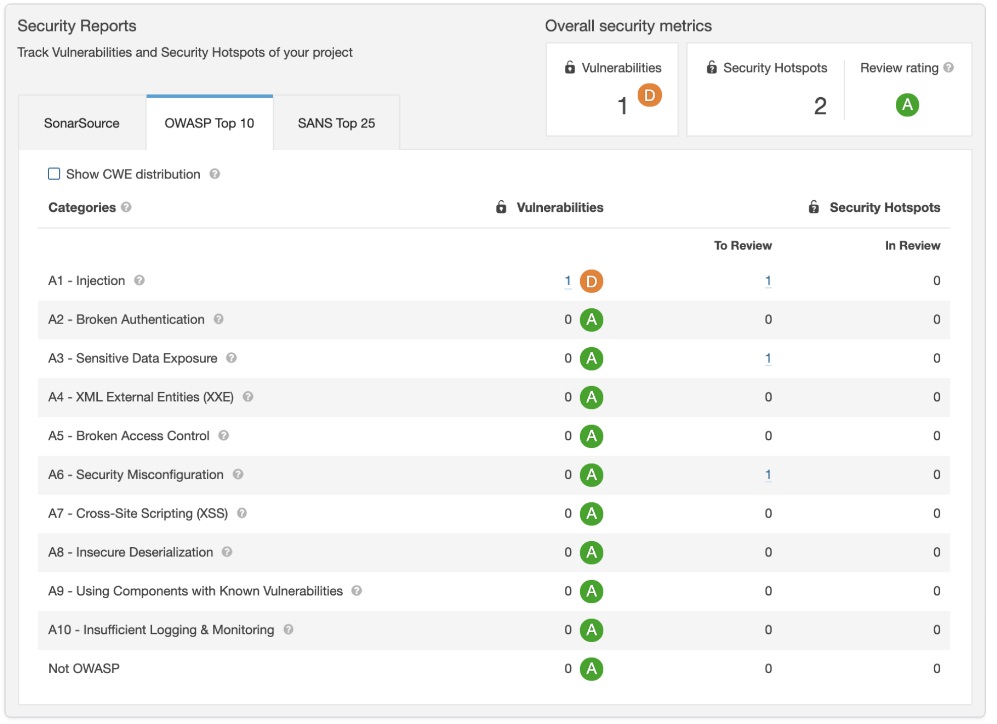
Security reports in Sonar: Owasp Top 10 benchmark (illustration)
Code Coverage and Complexity for Stronger Java Quality
SonarQube also helps Java teams improve code coverage and manage code complexity, which are key signals of code quality and long-term maintainability. Coverage analysis shows whether critical Java paths are exercised by tests, while complexity metrics help identify code that is harder to understand, review, and secure. Together with security rules and security reports, these capabilities give teams a stronger, more complete solution to make sure their code is not only secure, but also well-tested and high-quality.
Dependency Scanning for First- and Third-Party Java Code
SonarQube Advanced Security extends the platform beyond first-party Java code and into the software supply chain by adding dependency scanning for third-party and open source libraries.
That means your Java projects can be analyzed not only for insecure code written in-house, but also for vulnerabilities introduced through external dependencies, helping teams reduce risk across both 1st-party and 3rd-party code.
Together with static analysis, security rules, code coverage, code complexity, and security reports, this gives you a strong end-to-end solution to make sure your code is secure, well-qualified, and ready for production.
Final thoughts
SonarQube helps teams write more secure Java code by combining static analysis, security-focused rules, CI/CD checks, pull request analysis, and security reporting into one workflow. That makes it easier to catch vulnerabilities early, enforce secure coding standards consistently, and keep security visible across the software delivery lifecycle.
For Java teams, the result is a practical and scalable way to shift security left without slowing development down. SonarQube does not replace application security testing or threat modeling, but it does provide an essential layer of automated protection for everyday Java development.
We officially represent Sonar solutions and offer licenses, consulting, support and training.
For more details, contact us: sonar@almtoolbox.com or call us: 866-503-1471 (USA / Canada) or +31 85 064 4633
Related Links:
- Our Sonar webpage
- Customer Story: How a Global Luxury Automaker Controlled Unexpected Code Risks with SonarQube SCA and SAST
- What is SonarQube’s Current Offering?
- What’s in SonarQube for Developers and R&D Managers?
First release: July 2024