|
Getting your Trinity Audio player ready...
|
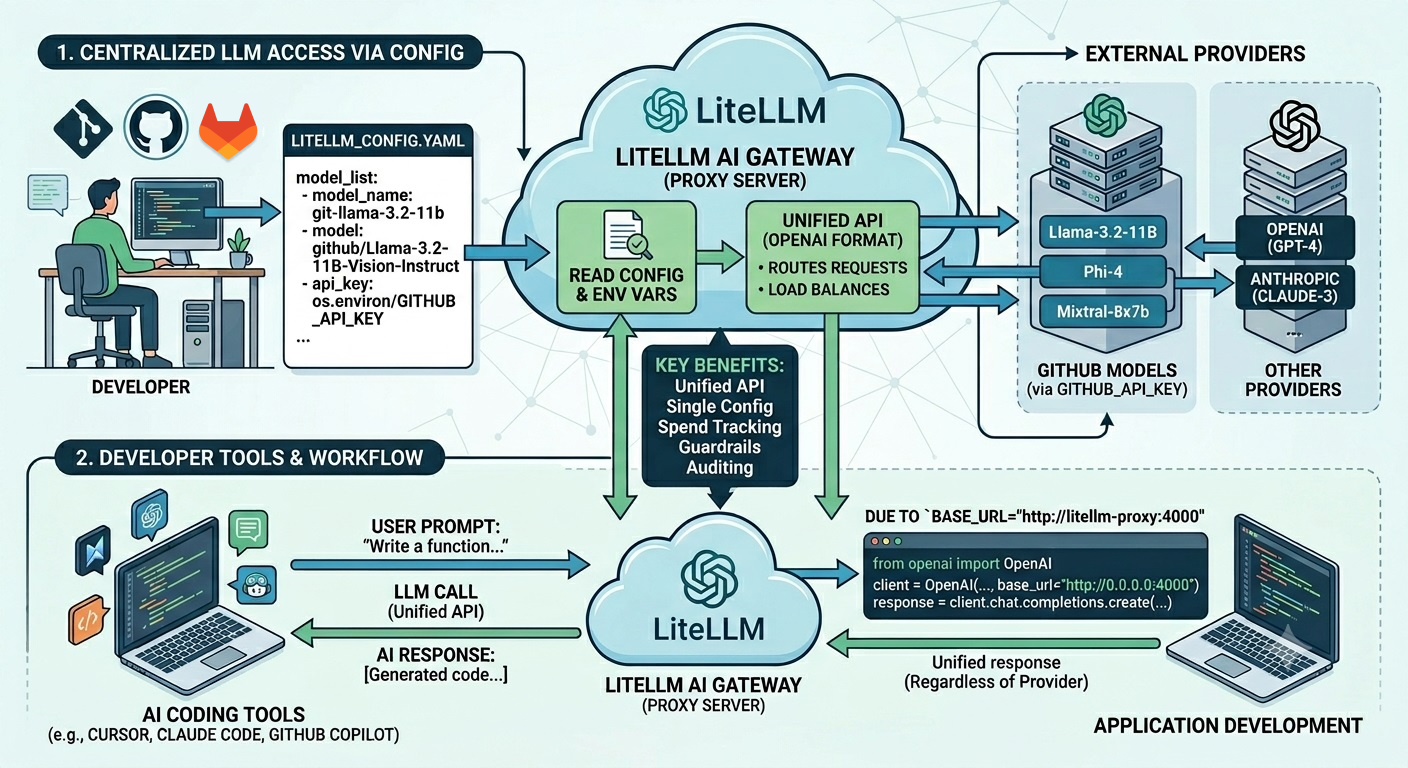
LiteLLM is a practical way to add AI capabilities to Git-based automation without locking yourself into a single model provider.
For teams using GitHub or GitLab, it can sit in the middle as a unified AI gateway for code review, commit assistance, merge request analysis, and CI-driven automations.
That makes it especially useful when you want flexibility across vendors, centralized governance, and a consistent API for your pipelines.
Why LiteLLM fits Git workflows
In git-based environments, the same AI capability often needs to work across different stages: commit time, pull request or merge request review, release preparation, and CI checks.
LiteLLM helps by giving you one OpenAI-compatible endpoint that can route requests to many model providers behind the scenes. That means your automation can stay stable even if you change models, add fallbacks, or move some workloads to self-hosted inference.
For DevOps and DevSecOps teams, this is a strong pattern because it keeps AI usage centralized.
You can add policy controls, logging, model allowlists, and cost tracking at the proxy layer instead of spreading those concerns across many scripts and repositories.
In practice, that makes AI features easier to standardize across GitHub and GitLab estates.
Common use cases
Here are practical ways to use LiteLLM in git-based workflows:
- Pull request or merge request review.
- Commit message generation.
- Security and compliance checks.
- Release note drafting.
- Documentation assistance.
- CI pipeline enrichment.
GitHub Actions example
This example shows a simple pattern where GitHub Actions calls a LiteLLM proxy during a pull request workflow. You can adapt the prompt to generate a review summary, a changelog draft, or a security checklist.
textname: AI Review with LiteLLM

on:
  pull_request:
    types: [opened, synchronize, reopened]

jobs:
  ai-review:
    runs-on: ubuntu-latest
    steps:
      - name: Checkout code
        uses: actions/checkout@v4

      - name: Get diff
        run: |
          git fetch origin ${{ github.base_ref }} --depth=1
          git diff origin/${{ github.base_ref }}...HEAD > pr.diff

      - name: Call LiteLLM proxy
        env:
          LITELLM_API_KEY: ${{ secrets.LITELLM_API_KEY }}
        run: |
          PROMPT=$(cat <<'EOF'
          Review the following pull request diff and provide:
          1. A short summary
          2. Potential risks
          3. Suggested improvements

          Diff:
          EOF
          )
          DIFF_CONTENT=$(cat pr.diff)

          curl -s https://litellm.example.com/v1/chat/completions \
            -H "Authorization: Bearer ${LITELLM_API_KEY}" \
            -H "Content-Type: application/json" \
            -d "$(jq -n \
              --arg model 'gpt-4o-mini' \
              --arg system "$PROMPT" \
              --arg user "$DIFF_CONTENT" \
              '{
                model: $model,
                messages: [
                  {role: "system", content: $system},
                  {role: "user", content: $user}
                ]
              }')"
This pattern works well when you want AI output as part of the workflow rather than a separate manual review step. You can also store the response as a PR comment, build artifact, or job summary.
GitLab CI example
In GitLab, the same idea maps cleanly to a merge request pipeline. This example uses a job that fetches the diff and sends it to a LiteLLM proxy.
textstages:
  - ai_review

ai_review:
  stage: ai_review
  image: alpine:3.20
  variables:
    GIT_DEPTH: "1"
  before_script:
    - apk add --no-cache git curl jq
  script:
    - git fetch origin "$CI_MERGE_REQUEST_TARGET_BRANCH_NAME" --depth=1
    - git diff "origin/$CI_MERGE_REQUEST_TARGET_BRANCH_NAME...HEAD" > mr.diff
    - |
      PROMPT="Review the following merge request diff and provide:
      1. A short summary
      2. Potential risks
      3. Suggested improvements"
      DIFF_CONTENT="$(cat mr.diff)"

      curl -s https://litellm.example.com/v1/chat/completions \
        -H "Authorization: Bearer ${LITELLM_API_KEY}" \
        -H "Content-Type: application/json" \
        -d "$(jq -n \
          --arg model 'gpt-4o-mini' \
          --arg system "$PROMPT" \
          --arg user "$DIFF_CONTENT" \
          '{
            model: $model,
            messages: [
              {role: "system", content: $system},
              {role: "user", content: $user}
            ]
          }')"
  rules:
    - if: $CI_MERGE_REQUEST_IID
This is a good fit for GitLab because merge request pipelines are already a natural place for automated checks. You can extend the same job to publish the response as a job artifact, post a merge request note, or feed the output into a downstream quality gate.
Implementation notes
If you are building this for a production environment, keep the prompt and response format structured.
For example, ask for JSON output so your pipeline can parse severity, summary, and recommendations reliably.
It is also wise to separate public models from sensitive repositories and route protected projects to self-hosted or approved providers only.
For GitLab-heavy environments, LiteLLM can also be useful as a compatibility layer in front of self-hosted or internal AI systems.
For GitHub-centric workflows, it gives you a way to standardize AI behavior across repositories even when teams prefer different models. In both cases, the real value is not just model access, but control and consistency.