|
Getting your Trinity Audio player ready...
|
In this article we go one level deeper and explain the main capabilities of the LiteLLM AI Gateway:
cost tracking, batches API, guardrails, model access, budgets, LLM observability, rate limiting, prompt management, S3 logging and pass-through endpoints –
and why DevOps / Platform / Architecture teams care about them.
As we recently shared, We (ALM Toolbox) officially represents LiteLLM as an AI Gateway solution for organizations that want to use GenAI safely and efficiently at scale.
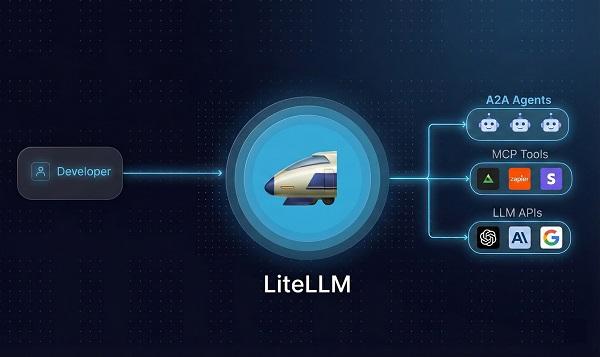
LiteLLM sits in front of 100+ LLM providers (including OpenAI, Claude/Anthropic, Gemini, Amazon Bedrock and local/Ollama models) and exposes a unified OpenAI-compatible API instead of many vendor-specific SDKs.
Why You Need an AI Gateway Today?
In many organizations each team starts using GenAI on its own: multiple providers, multiple API keys, no central visibility into costs, and almost no governance on what is sent to which model.
This quickly becomes a problem: CFOs start asking “who spent this money on LLMs?”, security teams worry about data sharing and tokens, and DevOps teams need a way to monitor and rate limit traffic.
LiteLLM solves this by acting as a central LLM gateway: all applications call the LiteLLM proxy (using the OpenAI format), and the gateway then routes requests to the right provider, applies guardrails, logs everything, and enforces cost and rate limits.
This means you can standardize your organization on https://your-litellm-gateway/ as the single endpoint for all LLM usage, both in cloud and in self-hosted environments.
What Is LiteLLM in a Nutshell?
LiteLLM is an open-source AI Gateway (LLM proxy) that exposes an OpenAI-compatible API while connecting behind the scenes to many different LLM providers and model types.
You can deploy it as a container or service (on-prem, in your private cloud or managed), define routing rules in a configuration file, and then give your teams virtual API keys that are decoupled from the raw provider keys.
Because all traffic passes through LiteLLM, you automatically get central cost tracking, budgets, rate limits, observability, audit logs, guardrails and prompt management – without changing your applications’ code beyond the base URL and key.
From our perspective this is similar to what an API gateway or reverse-proxy does for microservices, but tuned for the unique needs of GenAI and LLMs.
1) Cost Tracking: Finally See Who Spends What
One of the first challenges with GenAI is understanding LLM costs per team, project and environment.
LiteLLM proxies every request and writes detailed cost and token usage information into a PostgreSQL database, including provider, model, token counts, calculated cost, key, user, team and timestamps.
- Track spend by key / user / team / organization over time.
- See how much each model and provider actually costs you in real workloads.
- Export cost data to BI tools or chargeback reports for internal or external customers.
LiteLLM also exposes Prometheus metrics such as total cost and token usage per model and per key, so you can add Grafana dashboards that show real-time and historical spend for LLMs, just like you do for infrastructure.
For many organizations this is the first time they get accurate, per-tenant cost visibility across all GenAI usage.
2) Budgets and Rate Limit Tiers
On top of raw tracking, LiteLLM allows you to define Budgets and Rate Limit Tiers – reusable plans that limit how much each key / user / team is allowed to consume.
In the configuration you can define tiers with monthly dollar limits, token quotas, RPM (requests per minute) and TPM (tokens per minute) and then assign virtual keys to these tiers.
When a key hits its budget or RPM/TPM threshold, LiteLLM can automatically block further requests or return standard rate-limit responses, while metrics such as litellm_rate_limit_remaining help you monitor remaining capacity per tier.
This makes it easier to implement “plans” for internal teams or external customers (e.g. Free / Standard / Enterprise), each with its own budget and throughput constraints, similar to SaaS APIs.
3) Guardrails: Centralized Safety and Policy Enforcement
Another strong capability is Guardrails: the ability to apply safety, compliance and content policies to prompts and responses, in one central gateway.
LiteLLM lets you configure guardrails that run before a prompt is sent (pre-call) and/or after a response is generated (post-call), so you can block or transform traffic that violates your rules.
The gateway can integrate with provider-side guardrail systems such as AWS Bedrock Guardrails and can even load-balance guardrail requests across multiple deployments or accounts to stay under vendor limits.
Typical uses include blocking PII, enforcing allowed topics, sanitizing outputs for specific business domains, or plugging in your own guardrail logic that runs for all models in one place.
4) Model Access and Virtual Keys
LiteLLM introduces the concept of virtual API keys that are mapped to underlying provider keys and model lists, which is very useful for DevOps and security.
Instead of giving developers direct OpenAI or Anthropic keys, you issue LiteLLM keys with strictly defined allowed models and budgets, and rotate the provider keys behind the scenes as needed.
Routing is done via a model_list configuration where logical model names (for example gpt-4 or internal-english-model) are mapped to one or more providers and backends, including cloud LLMs and self-hosted / local models (e.g. via Ollama or vLLM).
You can also configure fallbacks and load-balancing between providers, so if one provider is down or throttled, LiteLLM can automatically try another while keeping the same OpenAI-style interface for your applications.
5) LLM Observability and Monitoring
Observability is critical when you run LLMs in production, and LiteLLM provides several layers of monitoring out-of-the-box.
The gateway exposes a Prometheus-compatible /metrics endpoint with metrics about request counts, latencies, token usage, cost totals and rate limits per model and key.
In addition, LiteLLM writes detailed structured logs and offers integrations with Langfuse, OpenTelemetry, Datadog, Helicone, Lunary, MLflow and others via callbacks and logging hooks.
This means you can trace requests end-to-end, correlate them with app logs and infra metrics, and build a realistic picture of how GenAI is used across your SDLC and production systems.
6) S3 Logging for Long-Term Retention
For organizations that need long-term retention or cheap cold storage of LLM logs, LiteLLM supports logging directly to S3 / GCS / cloud buckets using built-in callbacks.
By enabling the S3 callback in litellm_settings and configuring the bucket parameters, the gateway will serialize request/response metadata to JSON files and upload them to the bucket, typically partitioned by date and optional prefixes (such as team or environment).
There are options to separate audit logs (for compliance) from general request logs and send them to different buckets or prefixes, which is useful for regulated environments.
Once the data is there, your data team can run analytics in tools like Athena, BigQuery or Spark without touching production systems.
7) Batches API for Large-Scale Jobs
Some workloads (for example, scoring millions of records or running nightly analysis) are better handled via batch processing instead of many small synchronous calls.
LiteLLM supports an OpenAI-like Batches API, including /v1/files and /v1/batches style endpoints, where you upload a JSONL file with many requests and let the provider process them asynchronously.
Under the hood, LiteLLM can route these batch jobs to providers like vLLM and Amazon Bedrock Batch APIs, while still enforcing the same budgets, rate limits and logging rules as regular chat completions.
This is ideal for internal data-science teams that want to run big offline LLM jobs without bypassing governance and cost controls.
8) Prompt Management for Better Quality and Governance
As LLM usage grows, prompts become assets that need to be versioned, shared and governed – not just strings in code.
LiteLLM provides Prompt Management features that let you store prompt templates, version them and inject them into requests centrally, rather than hard-coding them in every microservice.
The gateway can integrate with existing prompt management tools via callbacks, and it also exposes a Prompt Management UI where you can upload prompt files (for example .prompt / .dotprompt) and grant specific keys access to chosen templates.
This enables patterns such as A/B testing prompts, rolling out prompt updates without redeploying apps, and enforcing which teams can use which official prompt templates.
9) Pass-Through Endpoints: When You Need Native APIs
While most apps can use the OpenAI-compatible interface, some cases require native provider endpoints – for example, Bedrock-specific APIs, OpenAI Assistants, or vendor-specific tools.
For this, LiteLLM offers Pass-Through Endpoints, which forward requests directly to the provider’s native APIs while still applying LiteLLM’s authentication, logging and (where relevant) budgets.
For instance, Bedrock pass-through endpoints allow you to call Bedrock via its native format while LiteLLM handles AWS credentials and routing.
Similarly, the OpenAI pass-through endpoint can proxy new OpenAI features (such as Assistants, Threads, Vector Stores or Responses) even before there is a generic abstraction, without losing centralized observability.
How We (ALM Toolbox) Can Help You Deploy LiteLLM
LiteLLM is powerful, but like any central gateway it should be designed and deployed carefully: high availability, security, observability, and integration into your existing CI/CD and DevSecOps stack.
As an official representative and partner, we (ALM-Toolbox) can help you plan and implement LiteLLM as part of your AI, DevOps and DevSecOps architecture.
Our services around LiteLLM include (among others):
- Architecture and design of your AI Gateway and LLM governance model.
- Installation and configuration of LiteLLM in on-prem, private cloud or air-gapped environments.
- Integration with GitLab, GitHub, Bitbucket, Azure DevOps and your CI/CD pipelines.
- Integration with Gen AI tools like Claude, Cursor, Open WebUI, Windsurf, Tabnine and more.
- Defining budgets, rate limits, guardrails and prompt management policies that fit your organization.
- Connecting LiteLLM to monitoring, logging and security tools you already use (Prometheus, Grafana, SIEM, etc.).
- Ongoing support, upgrades and hardening as your GenAI usage grows over time.
If you are considering an LLM / AI Gateway for your organization, LiteLLM is a flexible and open solution that fits well with modern DevOps and DevSecOps practices.
We will be happy to discuss your use cases, show demos and help you evaluate and deploy LiteLLM in a way that matches your security, compliance and budget requirements.
For more details, demos, an Enterprise trial license or a price quote for LiteLLM, you are welcome to contact us: litellm@almtoolbox.com or call us: 866-503-1471 (USA / Canada) or +31 85 064 4633 (Europe)